General information
1. Corporate structure and governance
Please click here to find comprehensive information.
Please click here to find comprehensive information.
No.
2. Treasury
Eurex Clearing has access to the intraday credit facility of the Deutsche Bundesbank.
Yes. Eurex Clearing has adequate credit facilities with a number of investment grade rated banks in place which, together with other liquidity sources, cover Eurex Clearing's intraday and overnight financing needs.
3. Regulation
On 10 April 2014, Eurex Clearing received a permission from the German Federal Financial Supervisory Authority to perform clearing services pursuant to Article 17 of Regulation (EU) No 648/2012 of the European Parliament and of the Council of 4 July 2012 on OTC derivatives, central counterparties and trade repositories (European Market Infrastructure Regulation, EMIR). The authorisation as EMIR-compliant CCP also determines Eurex Clearing as a qualifying CCP under Capital Requirements Regulation (CRR).
Eurex Clearing is also a credit institution under the German Banking Act and fulfils the requirements under the European legislation, in particular Capital Requirements Regulation (CRR) / Capital Requirements Directive (CRD IV).
Eurex Clearing is registered with the Commodity Futures Trading Commission (CFTC) as a Derivatives Clearing Organisation (DCO) for clearing OTC interest rate swaps for US Clearing Members in accordance with the Commodity Exchange Act.
Eurex Clearing AG has been recognized by the Swiss Financial Market Supervisory Authority FINMA as a foreign central counterparty and is considered by the Swiss National Bank as a systemically important financial market infrastructure for the stability of the Swiss financial system.
As a consequence, the list of the relevant authorities can be found below:
BaFin
Marie-Curie-Str. 24-28
60439 Frankfurt
Deutsche Bundesbank
(Central Administrations Center Frankfurt / Main)
Taunusanlage 5
60313 Frankfurt am Main
Deutsche Bundesbank
(Head Office) Wilhelm-Eppstein-Str. 14
60431 Frankfurt am Main
Swiss National Bank (SNB)
Börsenstr. 15
CH-8022 Zürich
Swiss Financial Market Supervisory Authority FINMA
Laupenstr. 27
CH-3003 Bern
Financial Conduct Authority (FCA)
25 The North Colonade, Canary Wharf
London E14 5HS
Yes, Eurex Clearing provides reporting to regulators due to different regulatory prescriptions and in different time periods.
Eurex Clearing reports to the following public authorities
- the Federal Financial Supervisory Authority (BaFin),
- the German Central Bank (Deutsche Bundesbank),
- the Swiss Financial Markets Authority (FINMA),
- Commodity Futures Trading Commission (CFTC),
- the Swiss National Bank (SNB).
For further information, please contact our regulatory section.
4. Compliance
Eurex Clearing AG is audited by an external auditor. The auditor is PricewaterhouseCoopers (PwC) and the audit takes place on a yearly basis.
Eurex Clearing AG rules are stipulated in the Clearing Conditions which are part of the general terms and conditions. Eurex Clearing AG reserves the right to amend the Clearing Conditions at any time; those amendments and additions shall be announced via electronic circular to the Clearing Members, Basic Clearing Members and/or other customers ("Affected Customers") at least fifteen (15) business days (Regular Notification Period) prior their effective date fixed in the relevant notice.
If Special Provisions are to be changed or amended, Eurex Clearing AG will carry out a Consultation and invite all Affected Customers to submit comments to the proposed changes and amendments and/or to express their desire for the application of a Prolonged Notification Period within one month after the publication of the relevant invitation. In case three or more Affected Customers request the application of a prolonged notification period, the notification period will be extended to three (3) months (“Prolonged Notification Period”).
Each Affected Customer accepts each amendment and addition to the Clearing Conditions, unless it objects by written notice to Eurex Clearing AG within the Regular Notification Period or the Prolonged Notification Period, Unless otherwise provided in the Clearing Conditions, all information to be published according to these Clearing Conditions shall be displayed for at least three business days, available here.
Every employee and external service provider of Deutsche Börse Group is obliged to adhere to the “Guideline for Keeping Professional and Banking Secrecy”. Professional Secrecy is the obligation for any employee to treat information obtained pursuant to professional activities confidential. Banking Secrecy is derived from this by adding specific provisions while limiting its application to employees of regulated entities. All information received within the conduct of professional activities must therefore be treated in the strictest confidence by employees and external service providers and must not be disclosed to any unauthorized party.
The adherence of client confidentiality is ensured by the implementation of diverse control systems like the Internal Control System (ICS), Group Compliance and Internal Auditing.
For further information please see also our annual report.
5. Services, membership and admission
Please click here to find comprehensive information.
Membership comes in two categories at Eurex Clearing - General Clearing Membership and Direct Clearing Membership.
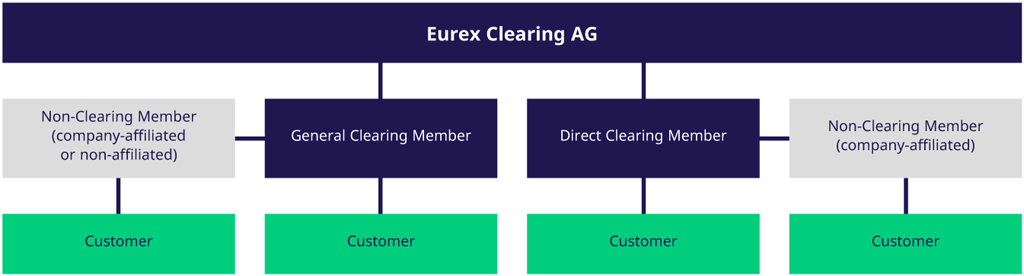
- A General Clearing Member (GCM) may clear its own transactions, those of its customers, as well as those of trading participants that do not hold a clearing license (known as Non-Clearing Member - NCM).
- A Direct Clearing Member (DCM) is entitled to clear only its own transactions, those of its customers, and those of its corporate affiliated NCMs. Only a Clearing Member - GCM or DCM - may be a counterparty of Eurex Clearing in a transaction.
As a result, legal relationships are essentially concluded between Eurex Clearing and a given Clearing Member, and in turn between that Clearing Member and the respective NCM.
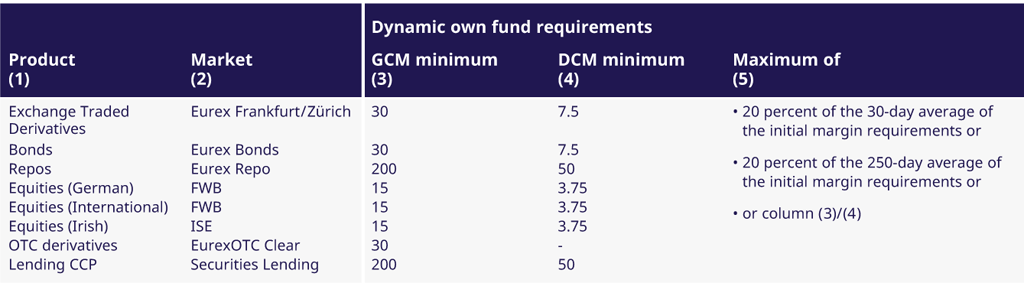
Applicants must be authorized and entitled by their respective regulatory authorities to operate in the custody and loan business as well as to accept receipt of margins in the form of cash and/or securities. In addition, Clearing Members must show evidence of a certain minimum level of own funds and must pay a contribution to Eurex Clearing’s Clearing Fund. Both the level of contribution to the Clearing Fund and the level of own funds depend on the status of the Clearing Member (GCM or DCM).
Own fund requirements, in EUR mn
Contribution to Clearing Fund, in EUR mn
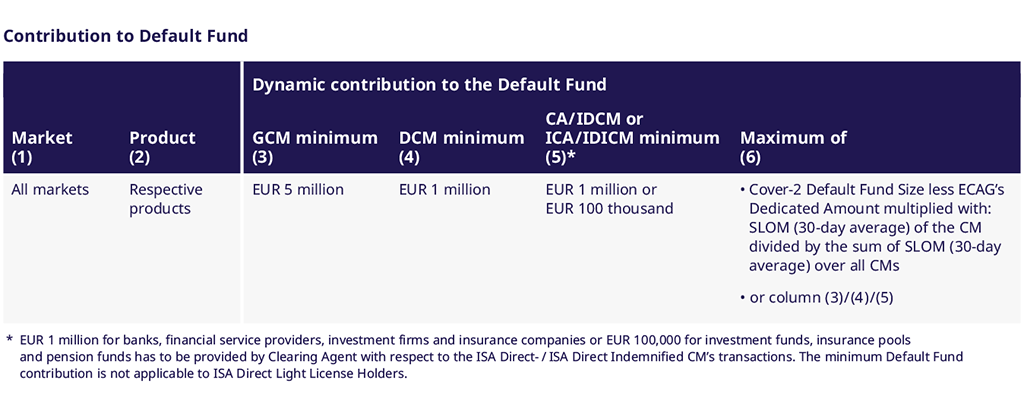
*Initial margin corresponds to the sum of futures spread margin and additional margin.
Additional admission requirements for all our Clearing Members include different accounts that they need to set up. Every member must hold accounts at a central securities depository for the deposit of collateral and execution of settlement related payments. Further, we require evidence of cash accounts for clearing related payments, e.g. premiums.
With our fee model, we encourage our members to conduct business at Eurex Clearing in multiple markets by taking advantage of economies of scale. For a first membership, applicants are charged a one-off admission fee as well as an annual membership fee. If a company wishes to become a Clearing Member for additional markets that we clear, no additional admission or membership fees are levied. In line with the markets that we serve, companies may apply for one or more of the following clearing licenses:
- Eurex Exchanges
- Eurex Repo
- Frankfurt Stock Exchange
- EurexOTC Clear
- Securities Lending
For further information, please also consult our webpage. Click here.
All forms necessary for the registration to the various Eurex Clearing service offerings can be found on our webpage under here.
We charge applicants a one-off admission fee of EUR 50,000 to become a Clearing Member, as well as an annual membership fee of EUR 25,000. We designed our fee model to encourage Members to take advantage of all the markets that we serve. For this reason, if you wish to become a Clearing Member for any of the other markets we clear we do not charge any additional admission or membership fees.
Additional fees with regard to different connection components and transaction volumes can be found on the Eurex Clearing Price List.
Please click here to find comprehensive information.
Please click here to find comprehensive information.
6. Risk
- What model is used to calculate initial margin?
Please click here to find comprehensive information.
- How is the default fund calculated for each member?
Please click here to find comprehensive information.
- Are there any intra-day calculations and if so is this called for?
Please click here to find comprehensive information.
- Are there any offsets against other products?
Eurex Clearing Prisma calculates combined risks across all markets cleared by Eurex Clearing. Cleared products that share similar risk characteristics are assigned to the same so-called Liquidation Group, which results in more comprehensive risk calculations enabling cross margining across positions within any Liquidation Group. Our margining method and default management process are closely aligned.
Please click here to find comprehensive information about liquidation group setup.
7. Collateral
Collateral deposit
The Clearing Member delivers the securities to the relevant account directly within the system of the chosen (I)CSD i.e. Clearstream Banking Europe (CEU), Clearstream Banking Luxembourg (CBL) or SIX SIS. All deposits are reflected near-time within the collateral management system of Eurex Clearing® C7. If a deposited ISIN cannot be accepted (due to ineligibility of the security or breach of concentration limit), Eurex Clearing instructs a near-time transfer back to the member's redelivery account.
In case a tri-party collateral management system is used, the Clearing Member needs to instruct an increase of a Collateral Claim.
Collateral withdrawal
Securities withdrawal instructions are entered using the “Collateral Transaction Entry” window of the Eurex Clearing® C7 system. Once confirmed by Eurex Clearing Operations that the margin requirement is still covered without the securities requested, the securities are transferred from the respective collateral account into the member's redelivery account. If a withdrawal request leads to an under-collateralization in the member’s account, the transfer of the requested securities is optionally postponed until the next business day or intraday until the appropriate amount of funds is in the account to fully cover the margin requirements.
Collateral Claim decreases need to be instructed via the tri-party collateral management system of the respective depository. Once confirmed by Eurex Clearing Operations that the margin requirement is still covered with the reduced claim amount, the tri-party collateral management system will move securities with a value up to the free amount to the respective source account.
Information about collateral
The Clearing Member may manage collateral on several windows on the Eurex Clearing® C7 GUI.
- Collateral Transaction Input / Collateral Transaction - Mass Input
The Collateral Transaction Input window is used for collateral withdrawals and deposits by a member and by Clearing Operations on behalf of a member. Members may withdraw securities or deposit/withdraw cash through this window. The Collateral Transaction – Mass Input window allows a fast entry of cash deposits or withdrawals for multiple pools at the same time. - Four Eyes Principal – Collateral
The Four Eyes Principal window for the collateral management allows the approval or rejection of
- transaction input/cancellation
- Permanent Cash Balance amendments.
The member can define on user level whether the four eyes principal feature is to be used. - Collateral Transaction Overview
The Collateral Transaction Overview window provides a variety of filter options to search for all or specific transactions that have been entered for a pool. Transactions generated out of the Mass Input can as well be found here. After settlement/cancellation any transaction can be historically enquired for approx. 60 days. - Collateral Transaction Details
The Collateral Transaction Details window provides detailed status information for a single collateral transaction including its entire history (status updates). After settlement/cancellation transaction details can be historically enquired for approx. 60 days. - Collateral Position Details
The Collateral Position Details window provides a variety of filter options to search for all or specific collateral positions (in cash, securities or claims) that are held in a pool. - Collateral Pool Status Overview
The Collateral Pool Status Overview window provides an overview of the overall values of cash, securities or claims in a pool and its current excess/shortfall. - Permanent Cash Balance (PCB) Maintenance
The PCB Maintenance window allows the member to define a minimum cash balance per currency that shall remain as cash collateral and hence will not be swept out in the end of day processing. - CSD Account Maintenance
The CSD Account Maintenance window allows the member to inquire all accounts that are setup for a respective pool.
Please click here to find comprehensive information.
8. Clearing operations
At Eurex, position limits exist according to § 14.7 of the Exchange Rules of Eurex Deutschland. The size of the respective limits can be learned from the product specifications on the Eurex Exchange website.
Trading Surveillance Eurex Deutschland is monitoring the adherence of the position limits intraday and is informing the Börsenaufsichtsbehörde Hessen as well as the Executive Board of Eurex in case of breach of the Exchange Rules. They then decide on whether to forward the statement of affairs to the sanction committee of Eurex Deutschland. In succession, the sanction committee is able to impose sanctions up to an amount of EUR 250.000 and/or to impose a temporary or definite expulsion from trade.
9. Disaster recovery/ IT-security
Yes, Deutsche Börse Group has implemented a formal crisis management process with defined responsibilities. The process applies Group-wide for all activities and organizational or legal entities, including Eurex Clearing AG.
The Crisis Management Team is composed of the Incident and Crisis Managers from the different divisions of Deutsche Börse Group. It is their role to ensure a coordinated incident response, including internal and external communication.
Yes, the BCM plans address the unavailability of systems, workspace, staff and suppliers. Supplier unavailability preparedness is regularly reviewed and generally addressed by service level agreements or multiple vendor arrangements.
All Systems except Xetra® are set up with an automatic fail-over process which makes the takeover immediate. Xetra® is set up fault tolerant, but disaster recovery requires a restart of the system at the back up site, which typically should be done within an hour. However, the general recovery time objective of Deutsche Börse Group in case of a disaster is 2 hours.
10. Business continuity
In case of technical issues emergency information is provided via the following media:
- System Newsboard
- SMS Service
- E-mail
Information on technical issues is distributed immediately if impact on members of Eurex has been recognized.
The responsibilities of Eurex and Eurex Clearing in an outage scenario are described within Section 12 on “Technical Problems” of the Technical Implementation Regulations of Eurex Deutschland and Eurex Zürich Concerning Technical Equipment.
French financial transaction tax (French FTT)
General aspects
The French Financial Transaction Tax (French FTT) applies, subject to the statutory exemptions, to acquisitions for consideration of qualifying equity securities or assimilated securities where:
- the acquisition results in a transfer of ownership;
- the securities are admitted to trading on a French, European or foreign regulated market;
- the issuer has its registered office in France; and
- the issuer’s market capitalization exceeded EUR 1 billion on 1 December of the year preceding the relevant tax year.
Only acquisitions are subject to the French FTT; disposals are not taxable as such.
The French Tax Authority publishes and updates the list of French companies meeting the applicable market-capitalization threshold. Market participants should refer to the official list applicable to the relevant tax year. The applicable list and further guidance are available on the website of the French Tax Authority.
Qualifying equity securities and assimilated securities may include:
- ordinary and preference shares;
- investment certificates and voting-right certificates;
- certain instruments giving or potentially giving access to capital or voting rights;
- certain convertible, exchangeable or share-linked securities; and
- depositary receipts representing qualifying French equity securities, including relevant American Depositary Receipts.
Whether a particular instrument is in-scope must be assessed based on the applicable statutory requirements and administrative guidance.
Derivative contracts are not subject to the French FTT on acquisitions of securities solely because they reference an in-scope security. However, the exercise, conversion, exchange or settlement of an option, derivative or other financial instrument may result in a taxable acquisition where qualifying securities are delivered and ownership is transferred, unless a statutory exemption applies.
Acquisitions of newly issued securities may qualify for the primary-market exemption, subject to the applicable legal requirements.
Certain corporate actions may result in an acquisition and transfer of ownership of qualifying securities. Such acquisitions may be subject to the French FTT unless a statutory exemption applies.
Which transactions are affected?
The French Financial Transaction Tax currently comprises:
- a tax on acquisitions of qualifying equity securities and assimilated securities issued by certain French companies; and
- a separate tax on certain cancelled or modified orders in connection with high-frequency trading.
This publication primarily addresses the French FTT applicable to acquisitions of qualifying securities in connection with Eurex Clearing AG’s clearing activities.
What is the tax rate and tax base for French FTT?
The French FTT on acquisitions of qualifying equity securities and assimilated securities is levied at a rate of 0.4% for acquisitions carried out on or after 1 April 2025. The tax is generally calculated based on the acquisition value of the qualifying securities.
- For acquisitions of listed securities, the taxable basis is generally the acquisition price determined in accordance with the applicable French FTT rules.
- The separate French tax on certain high-frequency trading activities is subject to its own statutory scope, calculation method and requirements and is not addressed further in this publication.
Who is liable to tax?
The French FTT applies to qualifying acquisitions irrespective of the purchaser’s nationality or place of residence and irrespective of the location of the trading venue.
The purchaser must be distinguished from the statutory taxpayer responsible for declaring and paying the French FTT. Depending on the transaction chain, the statutory taxpayer is generally the relevant investment service provider or, in certain cases, the purchaser’s securities account holder.
The separate tax on certain high-frequency trading activities is subject to its own rules concerning the taxable person and is not addressed further in this publication.
What is the meaning of "acquisition"?
Transactions may be taxable if and when they result in a transfer of ownership of qualifying securities. In general:
- the transfer of ownership takes place when the relevant securities are credited to the purchaser’s securities account;
- the French FTT is determined by reference to the settlement of the relevant acquisition; and
- the applicable netting rules may result in the tax being calculated by reference to the purchaser’s net buying position in the relevant security.
Transfers of qualifying securities in connection with collateral arrangements may fall outside the scope of the French FTT or qualify for an exemption, depending on the structure of the relevant arrangement and the applicable statutory requirements.
Are there any exemptions from the financial transaction tax in equities?
In principle, acquisitions within the scope of the French FTT are taxable unless one of the statutory exemptions applies. These exemptions include, subject to the respective legal requirements:
- acquisitions connected with the issuance of securities on the primary market;
- qualifying acquisitions made by clearing houses or central securities depositories;
- acquisitions connected with qualifying market-making activities;
- acquisitions carried out under qualifying liquidity agreements;
- qualifying intra-group transactions;
- qualifying securities lending and repurchase transactions;
- certain acquisitions relating to employee savings schemes or employee investment arrangements; and
- certain acquisitions of convertible or exchangeable bonds, without prejudice to the possible taxation of a subsequent acquisition of shares upon conversion or exchange.
The availability of an exemption must be assessed based on the facts and circumstances of the relevant transaction and the applicable legal requirements. Eurex Clearing AG does not determine whether an exemption is available to a Clearing Member, Trading Member, client or other market participant.
Persons or entities operating under foreign law may qualify for an exemption where the relevant activities or transactions satisfy the applicable equivalence requirements and the other conditions under French law.
Who is the statutory taxpayer responsible for declaring and paying the French FTT?
The statutory taxpayer is the person or entity legally responsible for determining, declaring and paying the French FTT.
Where an investment service provider executes a purchase order on behalf of a client or carries out an acquisition for its own account, the investment service provider is generally the statutory taxpayer, irrespective of its place of establishment.
Where several investment service providers are involved in the execution chain, the statutory taxpayer is generally the first investment service provider that receives the final purchaser’s purchase order for execution. Where an entity merely receives and transmits an order and is not authorized to execute it, the executing investment service provider may be the statutory taxpayer.
Where no investment service provider is involved in the execution of the transaction, the purchaser’s securities account holder may be responsible under the applicable rules.
The statutory taxpayer remains responsible for identifying taxable transactions and fulfilling the applicable declaration and payment obligations.
Does Eurex Clearing AG deduct, declare or pay the French FTT?
Eurex Clearing AG does not deduct the French FTT from the relevant acquisition amount and does not assume the responsibility of a Clearing Member or another market participant for determining, declaring or paying the tax.
Eurex Clearing AG benefits from the statutory exemption applicable to qualifying acquisitions by clearing houses. Where Eurex Clearing AG forms part of the relevant transaction chain, it provides transaction information available within the clearing process in accordance with the applicable legal and operational requirements.
The relevant statutory taxpayer remains responsible for:
- determining whether a transaction is within the scope of the French FTT;
- identifying and substantiating any applicable exemption;
- ensuring the completeness and accuracy of the relevant information;
- submitting the required declarations; and
- paying the French FTT within the applicable deadlines.
Clearing Members remain responsible for identifying and fulfilling any obligations applicable to their own transactions and, where relevant, transactions executed or cleared for their clients or Trading Members.
The tax treatment applicable to Eurex Clearing AG in its capacity as CCP does not determine the tax treatment or obligations of a Clearing Member, Trading Member or any of their clients.
What are the responsibilities of Clearing Members?
Each Clearing Member remains responsible for assessing the French FTT treatment of its own activities and transactions. This includes determining whether a transaction is within the scope of French FTT, whether an exemption applies and whether any reporting, notification or payment obligation arises.
The French FTT treatment applicable to Eurex Clearing AG in its capacity as CCP does not determine the tax treatment or obligations of a Clearing Member, Trading Member or any of their clients.
Disclaimer
This publication is provided for general information purposes only and does not constitute legal or tax advice. It does not provide a complete description of the French Financial Transaction Tax or of all potentially applicable exemptions, reporting requirements or payment obligations.
Clearing Members and other market participants remain responsible for assessing their own tax position, identifying the obligations applicable to their transactions and obtaining independent professional advice where appropriate.
Eurex Clearing AG does not assume responsibility for the tax treatment applied by a Clearing Member, Trading Member, client or other market participant. Applicable laws, administrative guidance and the list of in-scope securities may be amended from time to time.
Clearing Members should seek independent legal or tax advice where appropriate.
Spanish Financial Transaction Tax (Spanish FTT)
General aspects
Spain imposes a financial transaction tax (hereinafter, "Spanish FTT") on acquisitions for valuable consideration of shares of Spanish companies with a market capitalization exceeding EUR 1 billion on 1 December of the year preceding the acquisition. Those shares are admitted to trading on a Spanish market, a regulated market of another EU Member State or an equivalent third-country market. The Spanish FTT is generally levied at a rate of 0.2% on the taxable acquisition price, subject to the applicable statutory rules for determining the taxable base.
Which securities are in scope of the Spanish FTT?
The taxable event is the acquisition for valuable consideration of in-scope Spanish shares or depositary receipts representing such shares, provided that the applicable statutory requirements are met.
- The relevant shares must be issued by a Spanish company whose market capitalization exceeded EUR 1 billion on 1 December of the preceding year1. The Spanish Tax Agency publishes the list of Spanish companies meeting this capitalization threshold for the following calendar year. The capitalization criterion generally applies for the following calendar year irrespective of subsequent changes in market capitalization during that year.
- The relevant shares must be admitted to trading on a regulated market, which may be a Spanish market, a market of another European Union Member State, or an equivalent market in a third country.
- Acquisitions for valuable consideration of depositary receipts representing the shares, for example ADRs or ADSs, may also fall within the scope of Spanish FTT, irrespective of the place of establishment of the issuer of the depositary receipts.
- Acquisitions of in-scope shares or depositary receipts resulting from the exercise, conversion, execution or physical settlement of convertible or exchangeable bonds, derivative financial instruments or other financial instruments or agreements may also fall within the scope of Spanish FTT.
Which acquisitions may be subject to Spanish FTT?
Not every acquisition involving an in-scope security automatically gives rise to Spanish FTT. Whether Spanish FTT applies depends on the specific facts and circumstances of the transaction, including the nature of the acquisition and the availability of any applicable exemption. The Spanish FTT is applicable to acquisitions for valuable consideration of in-scope securities where all applicable statutory conditions are met and no exemptions applies. Acquisitions resulting from corporate actions may fall within the scope where they constitute an acquisition for valuable consideration of in-scope securities and no exemption applies. Not every corporate action automatically gives rise to Spanish FTT.
Which instruments or transactions are generally outside the scope?
The Spanish FTT concerns shares as defined in Article 92 of the Spanish Capital Companies Law:
Examples of potentially in-scope securities include:
- Shares; and
- depositary receipts representing shares, for example ADRs representing in-scope Spanish shares.
Examples of instruments generally not themselves subject to Spanish FTT include:
- debt instruments;
- units or shares in Collective Investment Vehicles;
- units or shares in Exchange-Traded Funds;
- derivatives; and
- instruments that do not result in an acquisition of in-scope securities.
Please note that derivatives are not themselves subject to Spanish FTT. However, the physical settlement of a derivative in in-scope shares may result in an acquisition subject to Spanish FTT, provided that the applicable statutory conditions are met an no exemptions applies. Similarly, convertible or exchangeable bonds are not themselves subject to Spanish FTT. However, their conversion or exchange may result in a taxable acquisition where in-scope Spanish shares or depositary receipts are transferred for valuable consideration.
Purely cash-settled transactions that do not result in a transfer of in-scope securities remain outside the scope of Spanish FTT.
Which exemptions may apply?
Acquisitions carried out by Eurex Clearing AG in the exercise of its regular clearing functions as a central counterparty are generally exempt from Spanish FTT. The exemption is limited to acquisitions undertaken by ECAG in the exercise of its relevant CCP functions and does not constitute a general exemption for all transactions involving ECAG.
Applicable reporting obligations nevertheless remain in place for exempt acquisitions made by ECAG in its own name and account in its capacity as CCP.
Applicable reporting obligations remain in place for exempt acquisitions made by ECAG in its own name and account in its capacity as CCP. Such acquisitions are generally included on a transaction-by-transaction basis in the reporting for the relevant monthly reporting period in accordance with the reporting process applicable to ECAG. Where the relevant CCP exemption applies, no Spanish FTT payment obligation should arise for ECAG in respect of the exempt acquisition, while the applicable reporting obligation remains in place.
Exempt acquisitions carried out by ECAG in its relevant CCP capacity are generally reported on a transaction-by-transaction basis for the relevant monthly reporting period through the reporting channel applicable to ECAG’s Spanish FTT reporting process.
The reporting of an exempt acquisition must be distinguished from the payment of Spanish FTT. Where the relevant CCP exemption applies, no Spanish FTT payment obligation should arise for ECAG in respect of that acquisition, while the applicable reporting obligation remains in place.
The Spanish FTT does not apply to certain acquisitions where the statutory requirements for an exemption are met. These may include, in particular:
- Appropriate functioning of secondary markets:
- CCP and CSD transactions: Acquisitions deriving from purchase, securities lending or other relevant transactions carried out by a central counterparty or a central securities depository in the exercise of their respective clearing or settlement functions.
- Liquidity agreements: Acquisitions carried out by financial intermediaries acting as liquidity providers, subject to the applicable statutory conditions.
- Market-making activities: Acquisitions carried out in the performance of qualifying market-making activities, subject to the applicable statutory requirements.
- Other potential exemptions:
- Intragroup transactions:
- Acquisitions of shares between entities of the same group within the meaning of Article 42 of the Spanish Commercial Code, provided that the applicable exemption requirements are met.
- Share buy-back programmes: Acquisitions of own shares or shares of a parent company within the context of a qualifying share buy-back programme, where the statutory purpose and other applicable exemption requirements are met. This may include programmes intended to reduce the issuer’s share capital, meet obligations arising from convertible financial instruments or meet obligations arising from employee or director share plans.
- Certain restructuring transactions: Acquisitions qualifying for the applicable special tax regime under Spanish Corporate Income Tax Law 27/2014, including qualifying mergers, divisions, contributions of assets and exchanges of securities, as well as certain qualifying transactions involving Collective Investment Vehicles, compartments or sub-funds.
- Securities financing transactions: Qualifying repurchase transactions, securities lending and borrowing transactions, buy-sell backs, sell-buy backs and margin lending transactions.
- Collateral transactions: Qualifying collateral arrangements involving a transfer of title, provided that the applicable statutory exemption requirements are met.
- Intragroup transactions:
The availability of an exemption depends on the facts and circumstances of the relevant transaction. The above list is provided for general information and should not be understood as an exhaustive or binding assessment.
What are the responsibilities of Clearing Members?
Each Clearing Member remains responsible for assessing the Spanish FTT treatment of its own activities and transactions. This includes determining whether an acquisition is within the scope of Spanish FTT, whether an exemption applies and whether any reporting, notification or payment obligation arises.
The relevant assessment should take into account the Clearing Member’s role in the transaction chain, the nature of the securities and transaction, the capacity in which the Clearing Member acts and any applicable statutory exemptions.
The Spanish FTT treatment applicable to ECAG in its capacity as CCP does not determine the tax treatment or obligations of a Clearing Member or any of its clients.
Legal basis and further information
The relevant legal framework and official guidance include, in particular:
Further information regarding the Spanish Financial Transaction Tax can be obtained from the applicable Spanish tax legislation, guidance issued by the competent Spanish authorities and other publicly available sources.
For the identification of potentially in-scope issuers and relevant regulatory information, Clearing Members should refer to the information published by the Spanish Tax Agency and seek independent legal or tax advice where appropriate.
Disclaimer
Eurex Clearing AG, hereinafter referred to as "ECAG", explicitly states that it does not provide legal and/or tax advice in relation to the Spanish Financial Transaction Tax. Each Clearing Member is solely responsible for assessing the Spanish FTT treatment of its own activities and transactions and for complying with any resulting legal obligations, including applicable reporting, notification and payment obligations.
This assessment must take into account the Clearing Member’s respective role in the transaction chain and any applicable exemptions.
ECAG assumes no liability for the completeness, accuracy or timeliness of the information provided.
For binding information, please consult a qualified legal or tax advisor. Nothing contained in this publication should be used as a substitute for the advice of competent legal or tax counsel. No written or oral communication provided by ECAG in this context constitutes legal or tax advice. In case of questions, uncertainties or comments, Clearing Members should consult their internal tax department and/or an appropriately qualified legal or tax advisor.
1 The Ministry of Taxes will publish before 31 December of each year the list of Spanish companies with a capitalization value exceeding 1 billion EUR on 1 December of the current year.
The inclusion of a company in that list does not by itself determine whether a specific acquisition is taxable, as the relevant transaction and any applicable exemption must also be considered.
U.S. Taxation
1. Clearing of potential Section 871(m) IRC transactions – General aspects
The U.S. Tax Authority (“Internal Revenue Service, IRS”) introduced comprehensive reporting requirements regarding derivatives transactions of in-scope assets for sec.871(m) IRC, in order to cover relevant income amounts (“dividend equivalent payments/amounts” = “DEP”/”DEA”) on an annual basis. The respective requirements are to be considered for relevant derivatives transactions with non-U.S. citizens / persons / aliens including foreign entities/companies documented via the Form W-8IMY.
A form W-9 from a U.S. domiciled Clearing Member would not trigger a sec. 871(m) IRC reporting by legal definition, U.S. citizens / persons /aliens are legally obliged to declare their income out of such transactions via dedicated tax forms on an annual basis with the U.S. Tax Authority. Eurex Clearing AG requires Form W-9 for clearing of derivative transactions with U.S. underlying products/assets potentially in-scope for sec.871(m) IRC derivatives transactions to ensure clarity, that such Clearing Members have their legal seat in the U.S.
Under Internal Revenue Code (“IRC”) Section 871(m) and the final regulations definitions, a “dividend equivalent payment/amount” = “DEP”/”DEA” is treated as a dividend from sources within the United States for the purposes of taxing and withholding at source on non-U.S. citizens/persons/aliens including foreign entities/companies. A dividend equivalent amount/payment is treated as dividend income also for purposes of any provision regarding dividends in an income tax treaty.
The definition of derivatives for the purposes of sec. 871 (m) IRC is very broad and includes so-called notional principal contracts (i.e. certificates, swaps, etc.) as well as equity-linked instruments (e.g. options, futures, forwards, contracts for differences, etc.).
An internal classification takes place at least once a year (beginning of calendar year) and will be considered valid during this period within the systems of Eurex Clearing AG. This classification is for internal purposes only. Clearing Members cannot derive any conclusions regarding their own classification of in-scope products from this information. In accordance with the legal requirements of the IRS, the classification of relevant and in-scope products for Section 871(m) IRC is the responsibility of the “determining/responsible party." Eurex Clearing AG acts in front of the IRS as “reporting party”.
Under Eurex Clearing AG internal assignment / classification purposes regarding sec.871(m) IRC currently the following criteria are considered:
a.) Derivatives such like options/futures on single stock products if
- the underlying securities are equities from an U.S. based/domiciled company
- if these U.S. equities are paying a dividend during the tax reporting period and
- if the derivatives have a delta equal to 1 (under current IRS guidance pursuant to Notice 2026-61, Section 871(m) generally remains limited to delta-one transactions through 31 December 2028. The applicable anti-abuse rule remains unaffected1)
b.) The assessment of derivatives on indices, baskets and ETFs is subject to the applicable requirements under Section 871(m) IRC and the relevant Treasury Regulations. Eurex Clearing AG’s internal assessment is for its own operational and reconciliation purposes only. The Clearing Member acting as determining/responsible party remains responsible for determining whether a transaction is in scope of Section 871(m) IRC.
1 Please refer to IRS notice 2026-61, "Extension of the Phase-in Period for the Enforcement and Administration of Section 871(m)", issued 21 September 2026
The following product categories may potentially be affected:
- Equity derivatives, including Single Stock Futures and Single Stock Options
- Futures and options on indices, baskets and ETFs
The legal obligations for sec.871(m) IRC derivatives shall be considered, regardless of physical delivery of the assets or of a cash delivery out of the execution of such derivatives.
Eurex Clearing AG is acting as Qualified Intermediary (QI) and Qualified Derivatives Dealer (QDD) in front of the U.S. Internal Revenue Service (IRS). The mandatory required legal agreement with the IRS is in place.
Eurex Clearing AG is acting as "reporting party" in front of the IRS and is therefore obliged to report the relevant derivatives transactions between the respective Clearing Member and Eurex Clearing AG in accordance with its own applicable reporting obligations. Eurex Clearing AG acts as reporting party towards the IRS and reports the relevant information relating to Section 871(m) transactions between the respective Clearing Member and Eurex Clearing AG in accordance with its own applicable reporting obligations. The relevant Form 1042-S reporting is performed within the applicable statutory filing deadlines.
The Clearing Member acts as the "determining / responsible party" regarding the definition of potential in-scope products for sec. 871(m) IRC derivatives transactions and in this capacity, must inform Eurex Clearing AG by the 10th day of the following month whether or not any derivative/s transaction is in-scope for sec. 871(m) IRC and, hence, is subject to reporting the calculated dividend equivalent payment/amount out of such transactions to Eurex Clearing AG (i.e. a nil reporting of assigned Clearing Member is mandatory).
2. Impact of Section 871(m) IRC derivatives transactions towards the Clearing Members
Non-U.S. domiciled Clearing Member
Eurex Clearing AG has limited the accessibility for clearing of potential in-scope products for sec.871(m) IRC derivatives transactions to certified QI’s assuming primary chapter 3 and chapter 4 withholding tax obligations or QDD’s.
Based on the contractual relationship between Eurex Clearing AG and its Clearing Member/s, Eurex Clearing AG is requesting from each Clearing Member, which would clear potential in-scope products/assets for sec.871(m) IRC derivatives transactions with Eurex Clearing AG, a valid Form W-8IMY tax form with the respective certification confirming at least one of the aforementioned options (e.g. QI/QDD). The relevant account number (Client Account/s, Proprietary Account/s, Market Maker Account/s) for which the potential transactions shall be cleared should be stated in Line 10 of the form, before any clearing in derivatives transactions could take place. Within the provided tax form W-8IMY the Clearing Member confirms his status as QI and / or QDD assuming primary withholding responsibilities for any U.S. withholding tax obligations.
The Clearing Member is obliged to ensure the valid and complete tax form/s with Eurex Clearing AG, in case of changes such like changes in legal structure, address, or other relevant changes the Clearing Member needs to ensure the presentation of the up-to-date tax form.
Such documented Clearing Member/s shall be marked in the Eurex Clearing AG system with a respective “Capacity Flag” in order to ensure the permission for clearing derivatives products/assets, potentially in-scope for sec.871(m) IRC.
Eurex Clearing AG performs an internal assessment of products potentially in scope of Section 871(m) IRC for operational, capacity and reconciliation purposes. The internal assessment performed by Eurex Clearing AG is solely for operational, reconciliation and reporting purposes and must not be relied upon by Clearing Members for their own tax determination under Section 871(m) IRC. This internal assessment does not replace the assessment to be performed by the Clearing Member acting as determining/responsible party.
U.S. domiciled Clearing Member
Such Clearing Member need to provide Eurex Clearing AG with a valid Form W-9 form (including the U.S. Tax Identification Number) before initiating any relevant transaction.
The Clearing Member need to share with Eurex Clearing AG all relevant reportable data (e.g. tax form 1042/1042-S, tax form 1099), which are filed with the IRS and are reflecting business with Eurex Clearing AG within a tax reporting year. The information shall be shared before the IRS filing deadline 15th March of the following year.
The Clearing Member is obliged to ensure the valid and complete tax form/s with Eurex Clearing AG, in case of changes such like changes in legal structure, address, or other relevant changes the Clearing Member needs to ensure the presentation of the up-to-date tax form.
Information is required from each Clearing Member acting as long party in such transactions for the purposes of tax form 1042/1042-S reporting and reporting reconciliation.
For the purposes of the Eurex Clearing reporting process, the Clearing Member identified as the Long Party must provide the relevant information in accordance with the applicable Clearing Conditions and reporting requirements.
As the Clearing Member long party is legally obliged to determine whether a derivative transaction is to be considered as a sec. 871(m) IRC derivatives transaction, the calculation of the so-called “dividend equivalent payment/amount (“DEA/DEP”) during a reporting/tax period need to be taken into account and reported via the tax form 1042-S / tax form 1042 towards the IRS [please refer to the Treasury Regulations § 1.871-15(c) and follows].
The Clearing Member, acting as long party must provide until the 10th of the following month whether or not the derivative transaction and the resulting calculated dividend equivalent payment/amount is in-scope for sec. 871(m) IRC derivatives transactions and, hence, is subject to the reporting to Eurex Clearing AG (i.e. a nil reporting of documented Clearing Member is expected).
Please refer to the information published within the last circular 046/24 (U.S. Tax Reporting: Update on the clearing of sec.871(m) Internal Revenue Code (IRC) transactions through Eurex Clearing AG).
Each Clearing Member, acting as Long Party, should request from Eurex Clearing AG a Form W-8IMY for documentation purposes.
Such request could be addressed to (Clearing Key Account Manager at the following email address: client.services@deutsche-boerse.com).
Please consider, that the Clearing Member is fully responsible for any U.S. withholding tax obligation, any payment of withholding taxes towards the IRS, and any reporting obligations out of derivatives transactions with their clients. Eurex Clearing AG is not in any case involved in this process.
The Clearing Member’s responsibilities also cover transactions executed by its Trading Members and cleared through the Clearing Member. Where information relating to Trading Member activity is required for Section 871(m) assessment, reporting or reconciliation purposes, the Clearing Member remains responsible for obtaining and providing the relevant information to Eurex Clearing AG within the applicable deadlines.
Eurex Clearing AG requires its documented Clearing Member/s to provide all relevant data and information required via a standardized reporting template from Eurex Clearing AG, which can be found under Rules & Regs > Regulations > U.S. Taxation, and which need to be provided to the following E-Mail address reporting871m@eurex.com covering the reportable data.
The assigned Clearing Member need to report monthly the relevant calculated income amounts (Dividend equivalent payment/amount) out of “received dividend distributions out of the applicable assets for sec.871(m) IRC” together with the holding positions in in-scope products/assets on business day end on Eurex Clearing AG account level.
Eurex Clearing AG shall reconcile the received reportable data with the data classified within the internal database; afterwards Eurex Clearing AG shall report the final aligned data, covering the relevant tax year, via the tax form 1042/1042-S to the IRS. Eurex Clearing AG currently targets completion of the relevant Form 1042-S reporting process by 15 March of the following year, subject to the applicable statutory filing requirements. Clearing Member, which have provided reportable data, will receive a copy of the filed form with the IRS.
Clearing Members must provide all required information in form and substance on account level, on a monthly basis, by the 10th day of the following month at the latest. All relevant documents and reports for the respective tax year must be submitted to Eurex Clearing AG by 10 January of the following year at the latest. Eurex Clearing AG have established an internal assessment, in order to ensure comprehensive reconciliation with the receivable data from the assigned Clearing Member within the tax period in consideration (tax year/calendar year).
Also “zero-reportings” from any documented Clearing Member/s is expected.
We kindly refer to our Clearing Conditions Chapter II Part 1 Number 1.7 Paragraphs (1) to (7).
Circulars from Eurex Clearing AG: No 028/2017, No 074/2017, No 021/2018, No 069/2018 and No 046/2024, and No 050/26 under the following link: https://www.eurex.com/ec-en/rules-regs/regulations/us-taxation
For further general information please refer also to the relevant publications from the Internal Revenue Service (IRS).
Eurex Clearing AG will prepare the tax form 1042-S for filing within the legal deadline towards the IRS and the assigned Clearing Member/s on basis of the received Clearing Member/s reportable data covering the calculations out of in-scope for sec.871(m) IRC derivatives transactions on tax reporting period basis.
In addition, Eurex Clearing AG shall prepare on calendar year basis the tax form 1042 covering the reporting obligations out of dividend equivalent payment/amounts in front of the IRS and ensuring a comprehensive reconciliation in conjunction with the filed 1042-S tax forms on Clearing Member level.
Please take into consideration, that Eurex Clearing AG will not report any transaction data out of the internal assessment, but in conjunction with the QDD Status of Eurex Clearing any potential deltas in filed tax forms 1042-S with the IRS and internal data of Eurex Clearing AG might be reported towards the IRS in accordance with section 7 out of the QI Agreement 2023 (please refer to 26 CFR 1.1441-1(e)(5) and (6), 2023 Qualified Intermediary Agreement, Rev. Proc. 2022-43).
Eurex Clearing AG (ECAG) does not provide legal or tax advice or tax assistance in relation to U.S. taxation or Section 871(m) IRC. The information provided is intended solely to support the operational understanding of the applicable U.S. tax reporting requirements. Clearing Members remain responsible for assessing and fulfilling their applicable legal and tax obligations and should consult their internal tax department or tax advisor where necessary.
All written and oral communication in this context is not considered to be tax advisory services. In case of questions, uncertainties or comments we kindly ask you to align with your internal tax department and/or your tax advisor.
